Title
Multitape Turing machines
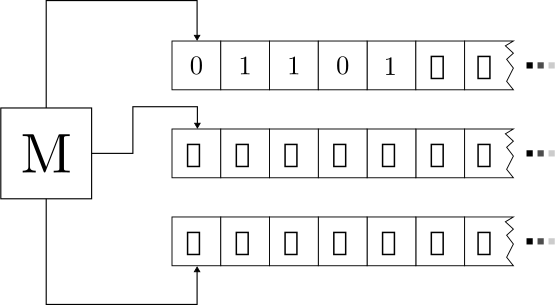
- A multitape Turing machine is an ordinary Turing machine but with \(k\) tapes.
Each tape has its own independent read/write head.
The input is loaded onto the first tape, and the other tapes start blank.
Its transition function has the signature: \[ \delta: \fragment{(Q \setminus \{q_a, q_r\}) \times} \fragment{\Gamma^k} \to \fragment{Q} \fragment{\times \Gamma^k} \fragment{\times \{L, R, S\}^k} \]
\[ \fragment{ \delta(q, a_1, \ldots, a_k) = (q', b_1, \ldots, b_k, m_1, \ldots, m_k) } \]
- Theorem: For every multitape Turing machine \(M\) there is a single-tape Turing machine \(S\) such that \(L(M) = L(S)\). Furthermore if \(M\) is total, then \(S\) is total.
- Proof idea: Construct \(S\) to simulate \(M\) on a given input.
Simulating a multitape Turing machine
In order to define \(S\), we have to describe how it:
- Encodes any configuration \(C_M\) of \(M\) as a configuration \(C_S\) of \(S\).
- Initially sets up its tape to simulate \(M\) (i.e., gets to the configuration encoding \(M\)’s initial configuration).
- Moves from \(C_S\) to a new configuration representing \(C'_M\) when \(C_M \to C'_M\).
Simulating multiple tapes: Configuration encoding
- A configuration of \(C_M\) looks like: \[ C_M = (q, p_1, \ldots, p_k, w_1, \ldots, w_k) \qquad\qquad\qquad \]
- Need to encode \(k\) tape head positions and contents!
- Special marker \(\markedCharacter{ }\) encodes that a tape head is at a cell:
- Graphically: replace \(a \in \Gamma\) with \(\markedCharacter{a}\) (e.g., \(\markedCharacter{\string{x}}, \markedCharacter{\string{0}}, \markedCharacter{\#}\)).
- Formally: we can represent marked/unmarked characters as tuples in \(\Gamma \cross \{\circ, \bullet\}\) (e.g., \((\string{x}, \circ)\) and \((\string{x}, \bullet)\)).
- To encode tape contents \(w_1\), \(w_2\), \(\ldots\), \(w_k\), we have a few options:
- Sipser’s approach: concatenate the tape contents with \(\#\) delimiters
marking their starts and ends (assuming \(\# \notin \Gamma\)). \[ \# w_1 \# w_2 \# \cdots \# w_k \# \] - Our approach: form “compound symbols” to represent the characters at the same cell of each tape.
- Graphically: a single smushed-together symbol like \(\string{b} \markedCharacter{\string{0}} \string{x}\) to represent three tapes with respective symbols \(\string{b}, \string{0}, \string{x}\).
- Formally: an element of \((\Gamma \cross \{\circ, \bullet\})^k\)
- Sipser’s approach: concatenate the tape contents with \(\#\) delimiters

Simulating multiple tapes: Setup and execution
- Given input \(x\), setup is easy in both variants.
- Sipser: \(\# \markedCharacter{x_1} x_2 \cdots x_n \# \markedCharacter{⎵} \# \cdots \# \markedCharacter{⎵} \#\).
- Write \(\# \markedCharacter{x_1}\).
- Copy the rest of the input from \(x\) with no markers.
- Write \(k - 1\) copies of \(\# \markedCharacter{⎵}\), followed by a final \(\#\).
- Ours: \(\markedCharacter{x_1}\markedCharacter{⎵}^{k - 1}\; x_2{⎵}^{k - 1} \; \cdots \; x_n{⎵}^{k - 1}\)
- Write \(\markedCharacter{x_1}\markedCharacter{⎵}^{k - 1}\)
- For each remaining character, write \(x_1⎵^{k - 1}\)
- Sipser: \(\# \markedCharacter{x_1} x_2 \cdots x_n \# \markedCharacter{⎵} \# \cdots \# \markedCharacter{⎵} \#\).
- To simulate each transition:
- Scan through the tape until all \(k\) markers are found, and remember the symbols under them.
This is a finite amount of information: \((a_1, \cdots, a_k) \in \Gamma^k\)) - \(M\)’s transition function can now be consulted \(\delta(q, a_1, \cdots, a_k)\).
- Do another pass through the tape the beginning, writing the appropriate symbols around each marked character to update the character and move the marker.
- Scan through the tape until all \(k\) markers are found, and remember the symbols under them.
Object encoding for Turing machines
- But programs can obviously operate on fancier objects than strings.
How can a Turing machine do this too? - For example, how can a TM read a graph?

Node and edge lists: \(\encoding{G} = \text{(binary encoding of)}\qquad (\fragment{(1,2,3,4)}, \fragment{((1,2),(2,3),(3,1),(1,4))})\)
Adjacency matrix: \[ \fragment{\begin{bmatrix} 0 & 1 & 1 & 1 \\ 1 & 0 & 1 & 0 \\ 1 & 1 & 0 & 0 \\ 1 & 0 & 0 & 0 \\ \end{bmatrix}} \fragment{\quad \Longrightarrow \quad \encoding{G} = } \fragment{0111101011001000} \hspace{15em} \]
How can we determine the number of nodes?
We use \(\encoding{O}\) to denote the encoding of an object \(O\) as a string in \(\binary^*\). We can encode multiple objects with \(\encoding{(O_1, O_2, \ldots, O_k)}\) or just \(\encoding{O_1, O_2, \ldots, O_k}\).